The Silk Road for Kids: Ancient Trade Route Explained
Learn about the Silk Road for kids! Discover how this ancient trade route connected Asia, Europe, and Africa, and changed history through trade, culture, and exploration.
WORLD HISTORYWORLD FACT FOR KIDS
6/17/20262 min read
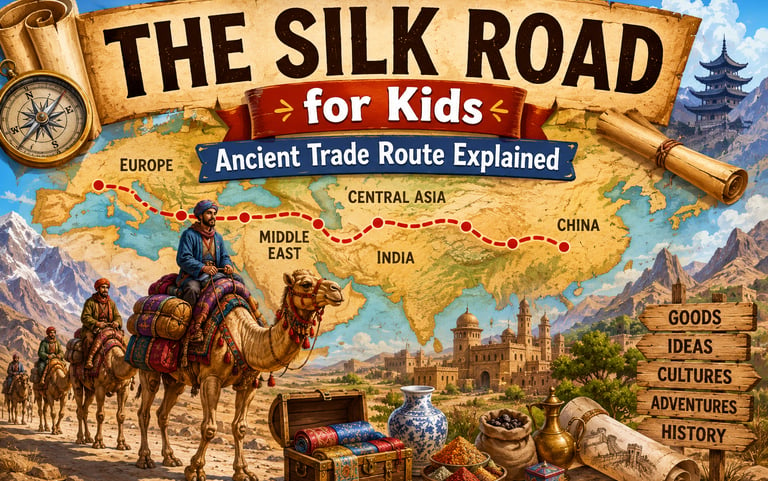
Imagine traveling thousands of miles across deserts, mountains, and cities without cars, trains, or airplanes. Long ago, merchants did exactly that on a famous network of trade routes called the Silk Road.
The Silk Road helped connect different civilizations and allowed people to exchange goods, ideas, cultures, and inventions. It became one of the most important trade networks in world history.
What Was the Silk Road?
The Silk Road was a network of trade routes that connected China, India, the Middle East, Africa, and Europe.
It was not a single road but many routes that stretched across thousands of miles.
Merchants traveled these routes to buy, sell, and exchange valuable goods.
Why Was It Called the Silk Road?
The route was named after silk, a valuable fabric made in ancient China.
Chinese silk was highly prized in Europe and many other regions.
People traveled great distances to buy this beautiful and expensive material.
When Did the Silk Road Begin?
The Silk Road began more than 2,000 years ago during ancient China's Han Dynasty.
Trade increased as kingdoms and empires grew stronger and safer routes were established.
The Silk Road remained important for many centuries.
Where Did the Silk Road Go?
The Silk Road connected many regions:
China
India
Persia (modern-day Iran)
Central Asia
Middle East
Europe
Important cities along the route became busy centers of trade and culture.
What Goods Were Traded?
Many valuable products traveled along the Silk Road.
From China
Silk
Tea
Paper
Porcelain
From India
Spices
Cotton
Precious stones
From Europe
Glassware
Jewelry
Metals
From Arabia
Perfumes
Incense
These goods were exchanged between merchants from different countries.
How Did Merchants Travel?
Traveling the Silk Road was difficult.
Merchants often traveled in groups called caravans.
Caravans usually included:
Camels
Horses
Donkeys
Camels were especially useful because they could survive long journeys across deserts.
Why Was the Silk Road Important?
The Silk Road did much more than transport goods.
It helped spread:
New Ideas
People learned about different cultures and traditions.
New Technologies
Inventions such as paper spread to other regions.
Religions
Religions traveled across continents through traders and travelers.
Knowledge
People shared scientific and geographical information.
Famous Traveler: Marco Polo
One of the most famous Silk Road travelers was Marco Polo.
He traveled from Europe to China and wrote about his adventures.
His stories helped many people learn about Asia.
Challenges of the Silk Road
Travel was often dangerous.
Merchants faced:
Harsh deserts
Mountains
Extreme weather
Bandits and thieves
Many journeys took months or even years to complete.
Amazing Silk Road Facts
1. The Silk Road Was Over 4,000 Miles Long
2. It Connected Three Continents
3. Camels Were Known as "Ships of the Desert"
4. Silk Was Worth Its Weight in Gold
5. Paper Spread Through Silk Road Trade
6. Spices Were Extremely Valuable
7. Traders Exchanged More Than Goods
8. Marco Polo Became Famous Through His Travels
9. The Route Helped Connect Different Civilizations
10. The Silk Road Changed World History
Why Is the Silk Road Still Important Today?
The Silk Road shows how people from different cultures can connect through trade and cooperation.
Many modern trade routes still link countries around the world, just as the Silk Road did centuries ago.
Conclusion
The Silk Road was one of the greatest trade networks in history. It connected people across continents and helped spread goods, ideas, inventions, and cultures.
Without the Silk Road, the world might look very different today.
Quick Quiz
1. Why was it called the Silk Road?
Answer: Because silk was one of the most important goods traded.
2. What animals were commonly used in caravans?
Answer: Camels.
3. Did the Silk Road only carry goods?
Answer: No, it also spread ideas, religions, inventions, and cultures.