
Why Did People Use Salt as Currency? The Surprising History of Salt Money
Long before coins and paper money, salt was so valuable that it was used as a form of currency in many parts of the world.
WORLD FACT FOR KIDSWORLD HISTORYCURIOUS FACTS
6/11/20262 min read
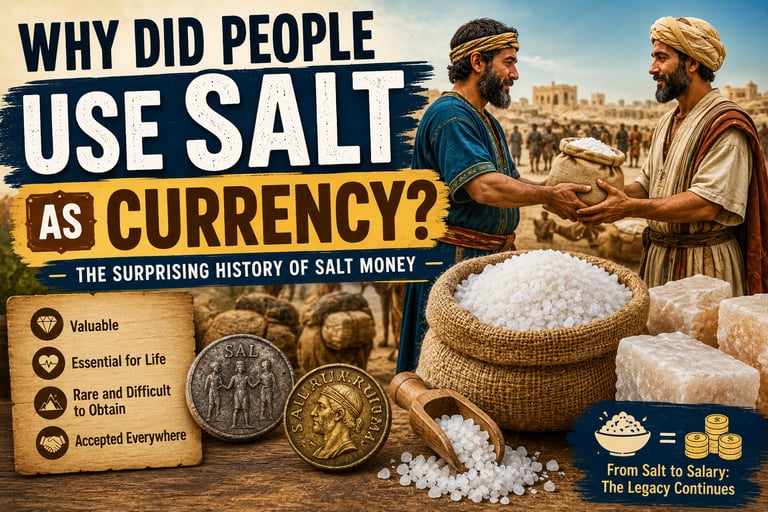
Imagine walking into a store and paying for your favorite toy with a bag of salt instead of money. It sounds strange today, but thousands of years ago, salt was one of the most valuable things in the world and was often used as a form of currency.
Let's discover why salt was so important and how it became one of history's earliest forms of money.
What Made Salt So Valuable?
Today, salt is inexpensive and easy to find. However, in ancient times, obtaining salt was difficult.
People needed salt to:
Preserve food before refrigerators existed
Add flavor to meals
Help keep the body healthy
Preserve meat and fish during long journeys
Because everyone needed salt, it became extremely valuable.
Salt as Money
Many ancient civilizations used salt as a form of payment.
Instead of coins or paper money, people exchanged salt for:
Food
Clothing
Tools
Livestock
In some places, workers even received salt as part of their wages.
The Roman Connection
Ancient Romans highly valued salt.
Roman soldiers often received money or allowances related to purchasing salt. Historians believe the English word "salary" comes from the Latin word "salarium," which was connected to salt payments.
This shows how important salt was in everyday life.
Salt Trade Routes
As demand for salt grew, important trade routes developed across the world.
Traders transported salt across:
Africa
Europe
Asia
Some salt caravans traveled hundreds of miles through deserts carrying blocks of salt that were worth a fortune.
Salt Blocks as Currency
In certain regions, especially parts of Africa, large salt blocks were traded like money.
People could exchange these blocks for:
Animals
Food
Gold
Other valuable goods
The quality and size of the salt block often determined its value.
Why Did People Stop Using Salt as Currency?
Over time, salt became easier to produce and transport.
As governments created official coins and paper money, salt slowly lost its role as currency.
Today, salt remains important, but it is no longer used as money.
Fun Facts About Salt Money
Some ancient trade routes were built mainly for transporting salt.
Salt was sometimes called "white gold."
Entire economies depended on salt production and trade.
In some places, salt was considered as valuable as precious metals.
What Can We Learn From Salt Money?
Salt teaches us an important lesson about money.
Something becomes valuable when:
People need it.
It is difficult to obtain.
Others are willing to trade for it.
Thousands of years ago, salt met all three conditions, making it one of the world's earliest forms of currency.
Conclusion
Before coins, paper money, and digital payments, people often relied on valuable everyday items for trade. Salt was one of the most important of these items because it helped preserve food and support daily life.
The next time you sprinkle salt on your meal, remember that this common kitchen ingredient was once valuable enough to be used as money!
Quick Quiz
Why was salt valuable in ancient times?
What modern English word may have originated from salt payments?
What nickname was sometimes given to salt?
Answers:
It preserved food and was difficult to obtain.
Salary
White Gold